Signs of AI Writing (And How to Avoid Them in Your Blog Posts)
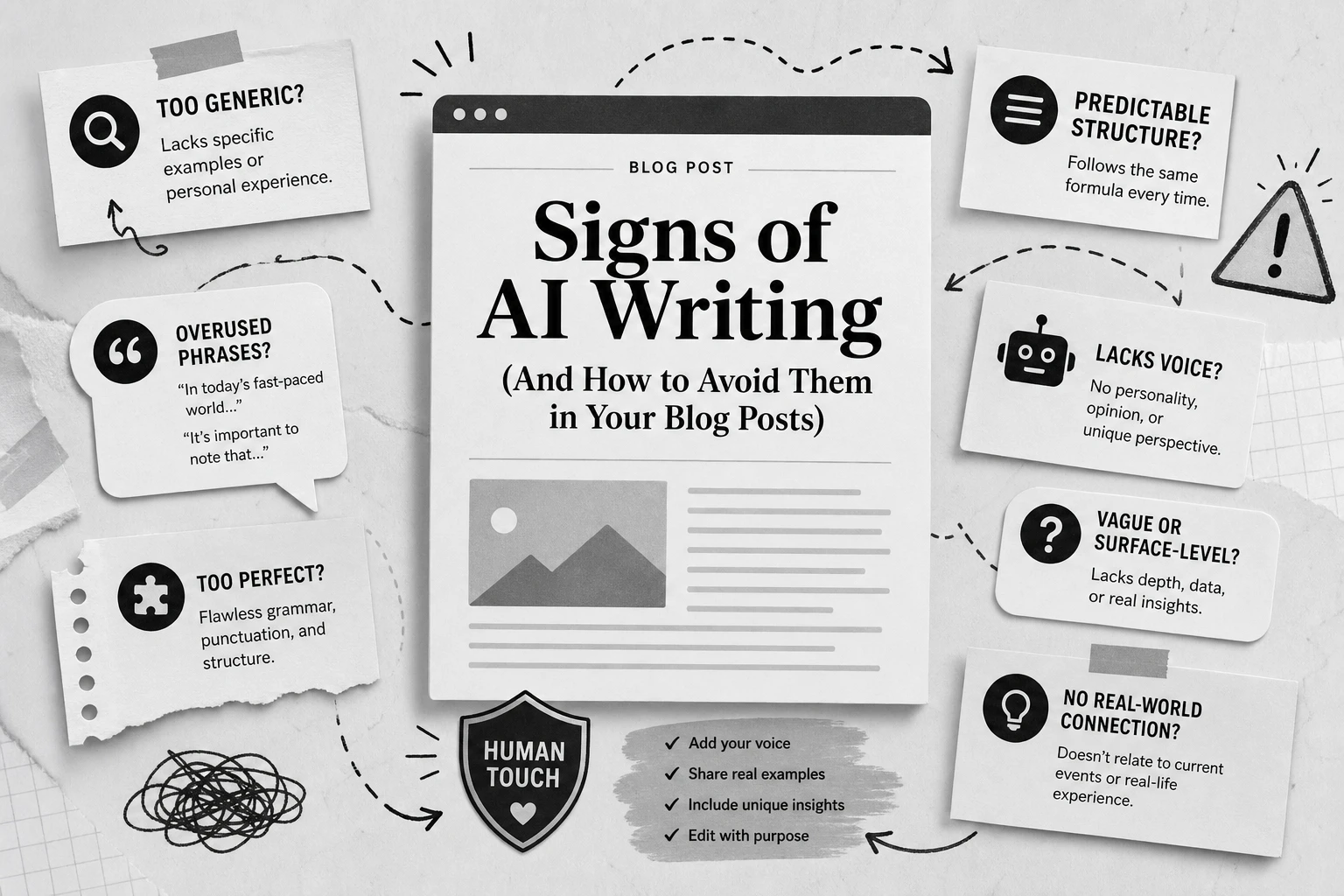
TL;DR: The signs of AI writing show up in vocabulary, structure, and content-not grammar. Overused filler words, "not X, but Y" constructions, uniform paragraphs, and vague examples give drafts away. The fix is better prompts up front, editing in passes, and adding specifics AI can't invent: real opinions, named examples, and lived experience.
The signs of AI writing are easy to miss, especially when you wrote the draft yourself. You know what you meant to say, so your brain fills in the gaps. But readers notice. The flat tone, the vague examples, the sentences that sound polished but don't actually say anything. Most people using AI tools end up with content that works grammatically but feels hollow and is easily identifiable as machine-written, and they can't quite explain why.
Here are the patterns that give it away, why they happen, and how to edit them out.
What makes text feel machine-generated
The signs of AI writing aren't spelling mistakes or grammar problems. They're subtler: patterns in rhythm, word choice and structure that make text feel oddly uniform. Like it was written by someone who knows every word but has nothing personal to say.
Why AI writes the way it does
AI generates text by predicting the next most likely word, based on patterns from enormous amounts of existing writing. That process naturally favors safe, middle-of-the-road phrasing. "Most likely" and "best" are not the same thing, and the gap shows.
AI-assisted vs. AI-obvious
AI-assisted writing means the tool helped you draft or structure ideas while you added judgment and a real point of view. AI-obvious is what you get when you publish the raw output without doing that work. Using AI isn't the problem, but skipping the edit for sure is.
The vocabulary tells
Overused filler words
This is something you might have heard about by now. Certain words show up in AI output so often they've become reliable signs of AI writing. A Florida State University study published in January 2025 identified 21 words whose frequency in scientific writing spiked dramatically in the past four years, with no explanation other than AI. The flagged words include "delve," "intricate," "meticulous," "pivotal," "realm," "tapestry," "underscore", "foster" and others. None of them are wrong per se. They just appear together so often now that readers sense something is off, even before they can name what. And this study is from last year, so new words and wording structured emerged since then as AI models progressed.
The "not X, but Y" construction
Scroll LinkedIn for five minutes and you'll see it everywhere. "It's not about working harder, it's about working smarter", "Not a cost, but an investment" – I see it constantly now, from social media posts to actual political communications, and once you notice it you can't unsee it. LinkedIn is supposed to be personal but it's become one of the clearest places to spot who's publishing raw AI output, because the "not X, but Y" construction keeps showing up in posts that are meant to sound like genuine professional insight. Real people don't write this way. AI reaches for it because it sounds like a sharp point without actually committing to one.
Filler openers and unnatural transitions
"It's important to note that...", "In today's world...", and "When it comes to..." are padding that fills space without saying anything. Same goes for connectors no person would actually use out loud. "Furthermore" and "Moreover" stacked in the same piece, "That being said" mid-paragraph for no clear contrast, "Additionally" at the start of nearly every new point. A real writer would just start the next sentence.
Signs of AI writing in structure
Paragraph shapes that signal AI writing
AI builds every paragraph the same way: introduce the point, support it, wrap it up. Repeated across an entire post, that tidy loop is one of the more reliable tells.
Some paragraphs should be one sentence. Others should trail off without resolving cleanly. This one does, for example.
List addiction
AI reaches for bullet points even when the ideas flow better as sentences. If your draft is full of "Here are five ways to..." sections, ask whether those ideas actually need a list or just got turned into one because lists feel organised without requiring real connective thought.
Robotic sentence rhythm
Read a paragraph aloud. If every sentence is roughly the same length and follows the same subject-verb-object shape, that's the problem. Short sentences land hard. Longer ones carry nuance before arriving somewhere. AI-generated text rarely mixes the two, and that flat, even quality is something you can hear before you can name it.
The content tells
Generic examples and missing specifics
"For example, a company might decide to..." is a tell. A human writer with real knowledge reaches for actual situations, names or moments. AI reaches for a vague stand-in because it has no experience to draw from. Same with "many studies suggest" – if you're citing something, link to it. If you can't, rewrite it as your own observation.
Saying everything, committing to nothing
"Some argue X, while others believe Y." Fine, but which side are you on? Human writers have a point of view. They might acknowledge the other side, but they usually land somewhere. AI presents all angles equally and closes with a vague summary, which is what makes so much AI content feel like thin content: words that cover a topic without really engaging with it.
Before and after: fixing AI writing
Rewriting a generic intro
Here's what a fairly typical AI blog intro looks like after a basic prompt with no extra guidance:
"Content creation is more important than ever. With so many businesses competing for attention online, having a strong blog strategy has become essential for standing out in a crowded market."
Two sentences, zero information. Cut both and open with the actual point:
"Writing a blog post used to take a full day. Now it takes less than an hour, but that speed comes with a catch."
Shorter, specific and it earns the reader's attention before they've even decided to stay.
Adding voice to a flat paragraph
AI draft: "There are several benefits to maintaining a consistent tone across your blog posts."
Human edit: "If your posts sound different every week, readers stop trusting that there's a real person behind them."
The second version makes a specific claim. The first just announces that a claim could exist.
Cutting the filler
AI draft: "It is important to note that, when considering the various aspects of this topic, there are many things worth keeping in mind."
Delete it. Nothing of value was lost. Removing throat-clearing is the single fastest improvement you can make to an AI draft.
How to avoid AI tells in your writing
Set better prompts from the start
Output quality is largely decided before the AI writes a single word. Give it a specific tone, a real point of view and actual constraints. "Write a 200-word intro for a skeptical small business owner who tried scheduling tools before and hated them" produces something far more usable than "write an intro about scheduling tools".
Vague in, vague out. Simple as that.
Edit in passes
Don't try to fix everything at once. First pass: cut filler openers and anything that announces importance without explaining it. Second pass: swap formal constructions and words nobody says aloud for language that sounds like you.
A slightly rough edited draft beats a perfectly smooth raw AI one. Every time. I'd rather publish something with a bit of friction that sounds like a person than something polished that sounds like nobody.
Add what AI can't
AI has no experience. It has no moment where something went wrong, no opinion it actually holds, no example from work it actually did. Even one or two real observations scattered through a post change the texture completely.
The "not X, but Y" pattern is a good test case. There's a specific moment when it stops looking like a rhetorical choice and starts looking like a tell – when you see it in a LinkedIn post, then a political speech, then a company announcement, all in the same week, all hitting the same beat. That moment of recognition is yours. It's also exactly the kind of thing an AI can't generate for you.
A note on tools: Skribt is the tool I built around this problem. You set a writing profile once and every draft starts from your tone and preferences rather than generic output. It doesn't remove the need to edit, but it shifts what you're editing for.
Write posts like this in minutes
Skribt helps you create SEO-optimized blog posts with AI without losing your voice.
Try Skribt free