SEO Success Stories: Real Examples With Traffic Data
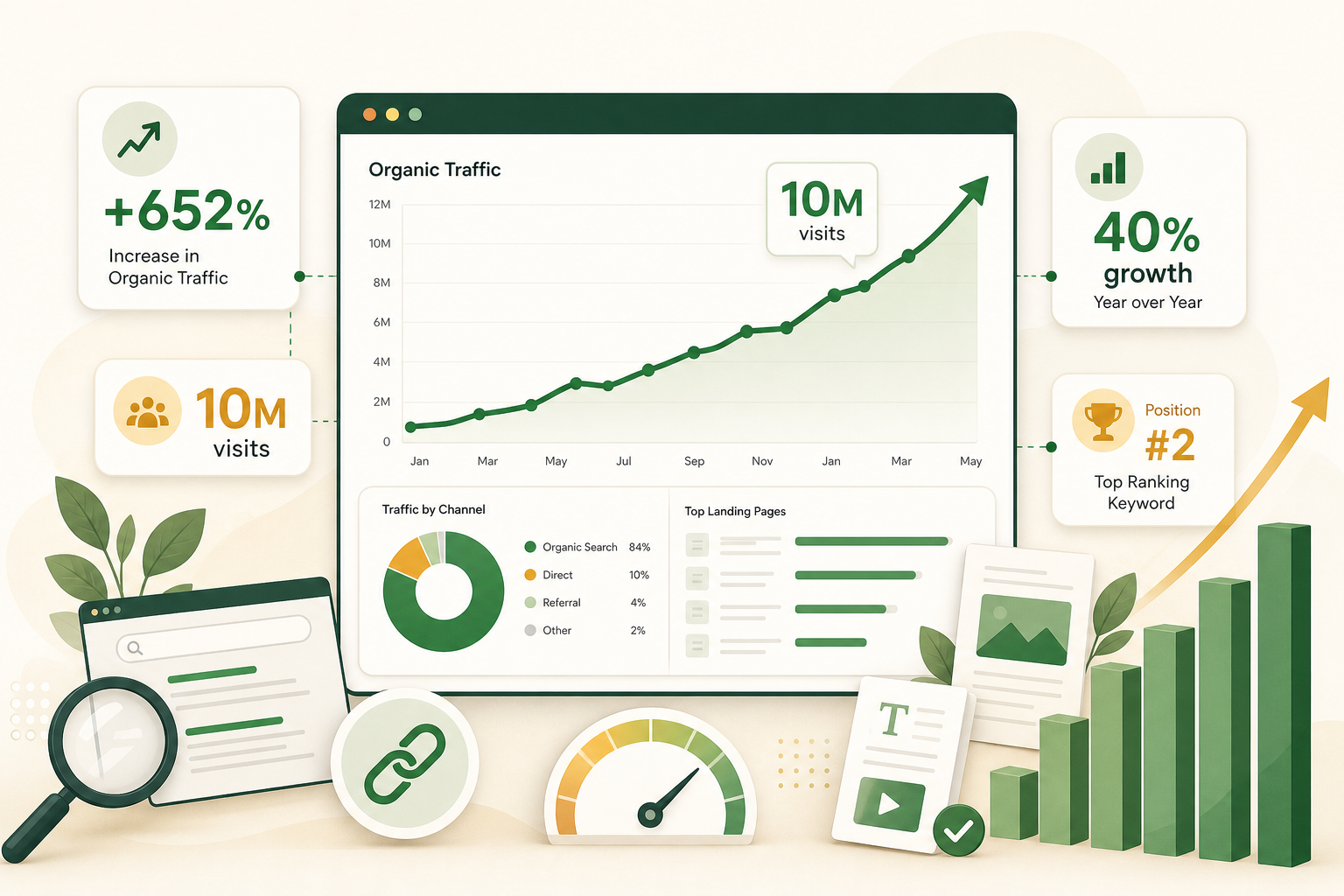
Everyone talks about Search Engine Optimization (SEO) theory, but few show receipts (even our own). This article is different! These are SEO success stories with actual traffic numbers and the specific strategies that made them happen. Verified wins from actual companies you can learn from and copy.
Why These SEO Success Stories Matter Now
Google has shipped more algorithm updates in the past two years than most SEOs can track. The Helpful Content Update, multiple core updates, and spam crackdowns have completely reshuffled rankings. What worked in 2022 might tank your site today.
The companies winning right now share common traits. They prioritize genuine expertise, invest in technical foundations, and build content that actually helps people. The SEO success stories in this piece all survived (or thrived through) recent algorithm chaos.
The Post-Helpful Content Update Landscape
Google's Helpful Content Update decimated sites built on thin, keyword-stuffed articles. Publishers relying on mass-produced content saw traffic drops of 50% to 90% practically overnight. Meanwhile, sites with genuine expertise and original research held steady or grew.
The new ranking factors reward:
-
First-hand experience and demonstrable expertise
-
Content that satisfies user intent completely
-
Technical performance (especially Core Web Vitals)
-
Clear author credentials and trust signals
-
Original data, research, or perspectives competitors lack
What Makes a Legit Case Study
Not all SEO case studies are created equal. Some are thinly veiled sales pitches with cherry-picked metrics. Others conflate correlation with causation. The examples in this article meet three criteria.
First, verifiable metrics. The traffic and ranking numbers can be cross-referenced with third-party tools or public statements. Second, clear timeframes. You know exactly how long each strategy took to produce results. Third, reproducible tactics. The strategies are specific enough that you could actually implement them, not just "we improved our content".
Technical SEO Wins That Moved the Needle
Technical SEO is unglamorous. It does not get the attention of viral content or flashy link building campaigns. But ignoring your technical foundation is like training for a marathon while wearing concrete shoes. These companies prove that fixing the basics can unlock massive growth.
Zapier's Programmatic SEO Overhaul
Zapier built one of the most impressive organic traffic machines in SaaS. Their programmatic SEO strategy now drives over 10 million monthly organic visits. The playbook: create template pages at scale for every possible integration combination.
Search "connect Slack to Google Sheets" and Zapier ranks. Search "automate Trello with Gmail" and Zapier ranks. They have thousands of these pages, each targeting specific long-tail queries that people actually search.
The magic is not just volume. Zapier's internal linking structure is incredibly tight. Every integration page links to related integrations, app category pages, and relevant workflows. This distributed link equity efficiently across millions of pages and helped Google crawl and understand the site's structure.
Timeline: Zapier built this system over several years, but the traffic hockey stick became visible within 12 to 18 months of serious investment. The compound effect is big, and each new integration page strengthens the entire network.
Canva's Core Web Vitals Fix
Canva is the design tool millions use daily. In early 2024, they faced a problem: their page speed scores were hurting rankings, especially on mobile.
Their engineering team focused on three Core Web Vitals metrics: Largest Contentful Paint (LCP), Cumulative Layout Shift (CLS), and First Input Delay (FID). They reduced LCP from over four seconds to under 2.5 seconds on key landing pages. CLS dropped to nearly zero through better image sizing and lazy loading.
Results: within three months of rolling out fixes, Canva saw ranking improvements across thousands of template pages. Pages that had slipped to positions five through eight climbed back to the top three. On competitive keywords like "resume templates" and "presentation maker", the ranking lifts translated to an estimated 15% to 20% traffic increase on those pages.
This is one of the SEO success stories where the fix was not one magic bullet. It was dozens of small optimizations: compressed images, deferred JavaScript, optimized fonts, and better server response times. Boring work that payed off big.
Content Strategy Plays That Crushed It
Content is still king, but the crown fits differently now, so to say. Quantity without quality is a liability. These companies show how strategic content decisions (including deleting content) drive serious results.
HubSpot's Content Pruning Experiment
HubSpot deleted over 3,000 blog posts. Let that sink in. One of the most successful content marketing operations in existence willingly removed thousands of articles from their site.
Why? Many of those posts were outdated, thin, or cannibalizing each other. Multiple articles targeting similar keywords split ranking signals and confused Google about which page to show.
Their criteria for cutting content:
-
Posts with fewer than 100 monthly organic visits
-
Outdated information that would require significant rewrites
-
Topics that no longer aligned with their business goals
-
Pages causing keyword cannibalization with higher-performing posts
Results: HubSpot stated that removing low-performing content improved crawl efficiency and allowed their best content to rank better. And traffic to remaining posts increased as Google focused crawl budget on quality pages. The pruning was paired with aggressive updates to high-potential posts, creating a one-two punch of removing junk and strengthening winners.
Ahrefs' Topical Authority Approach
Ahrefs dominates SEO-related search results. Their strategy: become the definitive resource on every SEO topic through comprehensive content clusters.
Take keyword research. Ahrefs does not just have one article about it. They have a pillar page on keyword research fundamentals, plus supporting articles on long-tail keywords, search intent, keyword difficulty, competitor keyword analysis, and local keyword research. Every piece links to related content within the cluster.
This approach signals topical authority to Google. When you cover a subject from every angle with interconnected content, search engines recognize your site as an expert on that topic.
Before and after: Ahrefs tracked ranking improvements when they rebuilt their link building content cluster in 2023. Their pillar page moved from position six to position two for "link building" within four months. Supporting articles saw average position improvements of three to five spots. Organic traffic to the entire cluster increased approximately 40%.
NerdWallet's EEAT Investment
NerdWallet operates in Your Money Your Life (YMYL) territory. Financial advice content faces extra scrutiny from Google because bad information could genuinely hurt people.
Their response: invest heavily in Experience, Expertise, Authoritativeness, and Trustworthiness (EEAT). Every article on NerdWallet now includes detailed author bios with credentials. Credit card reviews are written by actual financial analysts. Mortgage guides are reviewed by certified financial planners.
They also added clear citations, updated publication dates, and editorial review processes visible to readers. The "reviewed by" and "fact-checked by" badges are not just decoration. They signal trust to both users and Google.
Results: NerdWallet's organic traffic grew approximately 30% year-over-year through 2024 and 2025, even as many finance sites struggled with algorithm updates. Their YMYL content consistently outranks competitors who lack clear expertise signals. Credit card comparison pages that added expert reviews saw ranking improvements within two to three months.
Link Building Strategies With Receipts
Links still matter. A lot. But the spray-and-pray approach (GTA6 anyone?) of mass outreach to low-quality sites is dead. Let's discuss how to earn links that do move rankings.
Backlinko's Skyscraper Technique Results
Brian Dean's Skyscraper Technique remains one of the most documented link building strategies. The concept: find content that has earned lots of links, create something significantly better, then reach out to people who linked to the original.
Backlinko's own case study on this technique generated over 5,000 referring domains to a single piece of content about Google's ranking factors. The post took weeks to research and write, compiling data from multiple studies and adding original analysis.
Key metrics from their campaigns:
-
Email outreach conversion rate of approximately 11% (far above the 1% to 2% industry average)
-
Domain Rating growth from 71 to 86 over 18 months
-
Organic traffic increase of 652% on pages receiving Skyscraper links
The technique works because it offers genuine value. You are not asking for a favor. You are showing someone a legitimately better resource than what they currently link to.
Siege Media's Data-Driven Content Wins
Siege Media built their agency on creating original research that earns links naturally. Their approach: conduct studies, analyze data, and publish findings that journalists and bloggers actually want to cite.
One campaign for a client in the pet industry analyzed veterinary data to create "The Most Popular Dog Breeds by State" with original maps and visualizations. That single piece earned over 300 referring domains from sites like USA Today, local news outlets, and pet blogs.
Another campaign surveyed remote workers about productivity habits. The resulting data earned coverage from major business publications and drove significant brand visibility alongside links.
Siege Media reports that their data-driven content earns an average of 50 to 150 links per campaign, with top performers exceeding 400. The key is creating genuinely newsworthy research, not just repackaging existing data. Original surveys, proprietary data analysis, and unique visualizations outperform everything else.
Timelines and Takeaways You Can Use
Knowing what worked is only half the battle. Understanding when it worked helps you set realistic expectations and plan your own strategy.
90-Day vs 12-Month timeframe
SEO results come in two flavors: quick wins and compound gains.
Quick wins (visible within 90 days):
-
Core Web Vitals fixes (Canva saw ranking lifts within three months)
-
Title tag and meta description optimization
-
Fixing technical crawl issues
-
Adding EEAT signals to existing high-ranking content
-
Internal link improvements to existing pages
Compound gains (12 months or longer):
-
Building topical authority through content clusters (Ahrefs saw full impact around four to six months)
-
Programmatic SEO at scale (Zapier's traffic took 12 to 18 months to hockey stick)
-
Link building campaigns (domain authority growth is gradual)
-
Content pruning effects (HubSpot measured impact over six months)
The mistake most people make is abandoning strategies before compound gains kick in. Technical fixes show fast results, which is great for building internal buy-in. Content and link building take longer but deliver bigger payoffs.
Patterns Across All These Wins
Every one of these SEO success stories shares common threads. Recognizing them helps you build a framework for your own strategy.
Pattern one: technical foundation first. Zapier, Canva, and every other winner ensured their sites were crawlable, fast, and technically sound before scaling content. Pouring content onto a broken site is unfortunately wasted effort.
Pattern two: depth over breadth. Ahrefs and NerdWallet do not try to rank for everything. They pick topics and own them completely. Being the best resource on 20 topics beats being mediocre on 200.
Pattern three: original value. Siege Media's data studies, Backlinko's comprehensive guides, and NerdWallet's expert reviews all offer something competitors lack. Rehashing existing content does not cut it anymore.
Pattern four: patience plus iteration. Nobody hit publish and walked away. HubSpot pruned and updated continuously. Ahrefs refreshes content regularly. These are ongoing programs.
Where should you start? If your technical SEO is shaky, fix that first. If your foundations are solid, identify one topic cluster where you can build genuine authority. Create content worth linking to. Then give it time.
These SEO success stories prove that sustainable organic growth is still possible. It just requires strategy, execution, and patience. The companies winning today invested in quality when others chased shortcuts. Your turn.
Written by Paul Plessing
Write posts like this in minutes
Skribt helps you create SEO-optimized blog posts with AI without losing your voice.
Try Skribt free