EEAT AI content: how to rank when you write with AI tools
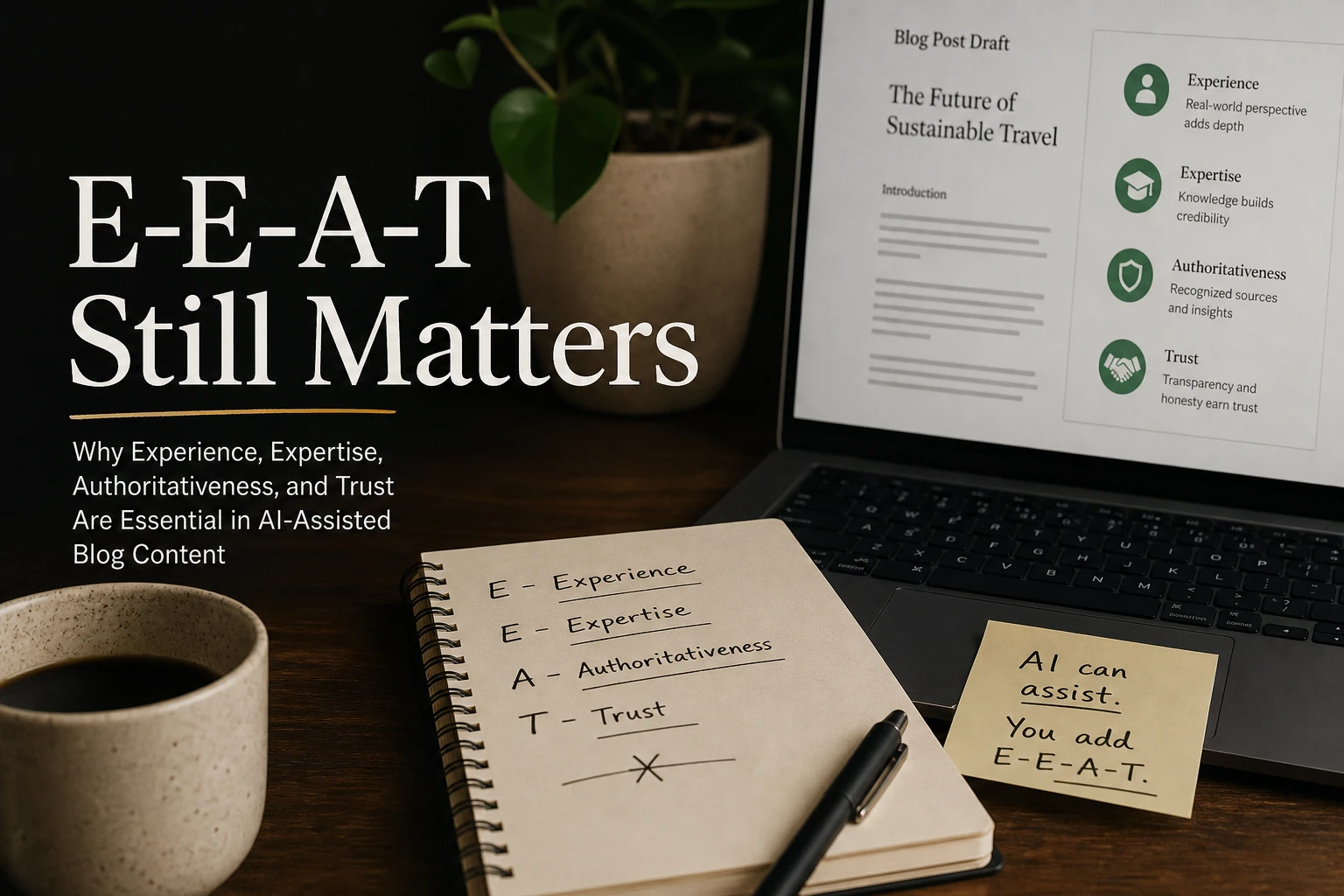
TL;DR: Using AI to write does not hurt your rankings-what hurts is publishing content without your expertise layered back in. Google evaluates EEAT signals like firsthand experience, author credibility, and verifiable claims, and these are exactly what generic AI output lacks. The fix is a workflow where you control the topic and angle, add personal perspective during editing, and stay transparent about how content was researched and shaped.
Getting EEAT AI content right is the difference between a blog post that ranks and one that gets buried. Experience, Expertise, Authoritativeness and Trustworthiness (EEAT) were always important signals for Google, but they matter even more now that AI-generated content is everywhere. Search engines have had to get better at spotting the difference between content written by someone who actually knows their subject and content that just sounds like it does.
The good news is that using AI to write does not automatically put you at a disadvantage. What matters is how you use it. This guide covers the EEAT signals that make the biggest difference for solopreneurs and small business owners, and the workflow changes that keep your expertise front and centre even when AI is doing a chunk of the drafting.
What EEAT means and why Google cares
Google does not rank pages purely on keywords and other easily quantifiable indicators. It also tries to judge whether the person or organisation behind a piece of content actually knows what they are talking about. That judgment comes down to a framework called Experience, Expertise, Authoritativeness and Trustworthiness (EEAT). Google added "Experience" to the original E-A-T framework in December 2022, shifting the emphasis from academic-style credentials toward real-world, firsthand knowledge.
The four signals explained
Each letter covers a different dimension of quality:
- Experience asks whether the author has had genuine contact with the topic, not just read about it.
- Expertise looks at the depth of subject-matter knowledge behind the content.
- Authoritativeness considers how the wider web and industry perceive the source.
- Trustworthiness checks for accuracy, transparency and honest intent. A page that scores well on the other three signals but falls short on trust will still receive a low overall EEAT evaluation.
Why EEAT matters even more for AI content
When content is generated at scale with AI, the experience and expertise signals are the first things to disappear. Generic, polished prose without a human perspective is exactly what Google's quality raters are trained to flag. For EEAT AI content to rank, it needs deliberate signals layered back in, things like personal perspective, author context and verifiable claims. Ignoring this is what separates forgettable thin content from posts that actually earn traffic.
The real problem with most EEAT AI content
The issue is rarely that AI wrote the content. It is that the human who commissioned it quietly stepped aside. When that happens, the output loses the one thing search engines and real readers both look for: a perspective that could only come from someone who has actually navigated the subject.
Experience is the hardest E to fake
Generic AI prose is fluent and forgettable in equal measure. It covers a topic the way an encyclopedia would, without friction, without doubt and without the kind of specific observation that signals lived knowledge. Readers feel this immediately. A post that explains a process without ever acknowledging where it gets complicated reads as thin content, regardless of how polished the sentences are.
Generic AI output vs expert-guided AI output
Two writers using the same AI tool can produce completely different results. One pastes a topic into the prompt and publishes what comes back. The other brings their own framing, corrects assumptions the AI makes, adds context from their own work and shapes the angle deliberately. The tool is identical. The human involvement is not. Google's focus is on output quality, which means the second approach survives where the first one struggles.
Practical ways to add EEAT signals
Knowing what EEAT requires is one thing. Putting it into your posts is another. Here are three places where small changes make a visible difference.
Author bios and credentials
A brief bio at the top or bottom of every post connects your content to a real person. As Fractl point out, a well-crafted author bio is one of the simplest ways to show search engines that someone with verifiable experience wrote the piece. Include your role, relevant background and a link to other published work. If you have a professional profile elsewhere, link to it. That off-site trail reinforces your author entity and gives both Google and readers something concrete to evaluate.
First-person examples and opinions
Generic summaries of a topic read like thin content because they are. What separates your post from the next one on the same subject is your actual point of view: a decision you made, a mistake you learned from, a workflow you use. You do not need polished case studies. A single honest paragraph about how something played out in your own work adds more credibility than three paragraphs of neutral explanation.
Citing sources and showing your methodology
Transparency about how you researched a topic builds trust fast. When you link to a source, briefly explain why you trust it rather than dropping a bare URL. If you used an AI tool to draft or research, say so and describe how you verified or shaped the output. Readers and quality raters both respond to honesty about your process, and it signals the kind of considered approach that holds up to scrutiny.
The workflow that keeps expertise yours
Stay in control of topic, angle and outline
The decisions that define a piece of content are not the ones AI makes. They are the ones you make before the writing starts: what angle to take, which audience to address, what to leave out. Handing those choices to an AI by default is how content ends up generic. Tools like Skribt are built around the idea that you set the topic and direction first, then let AI handle the research and drafting inside that frame. You also set a writing profile once, covering tone and formatting, so every output reflects your voice rather than a default style.
Edit for experience, not just grammar
Most people treat the revision stage as a polish pass: fix the typos, tighten the sentences, move on. That misses the real opportunity. The revision stage is where you add the layer that AI cannot generate on its own: your actual perspective. Read each section and ask whether it says something only you could say. Where it does not, add a sentence that does. That might be a nuance from your industry, a caveat that changes the advice or an honest acknowledgment of where the answer gets complicated. That kind of editing turns AI-assisted drafts into content that holds up under scrutiny and keeps readers on the page longer, which matters for time on page as much as for credibility.
Why AI-assisted content can outperform pure human content
The competitive edge is not in choosing AI over human writing or the other way around. It is in combining both deliberately. Used well, AI-assisted content can cover more ground, hold a consistent structure and leave you free to do the one thing no tool can replicate: bring your own perspective to it.
Better research coverage and consistency
AI is fast at pulling together a broad picture of a topic, which means your drafts start with fewer gaps than a rushed solo effort might. That breadth matters, but it only becomes useful when you layer in the depth that comes from real experience. Think of it as skyscraper content built on a solid frame rather than a shaky one. The structure is there; your job is to fill in the floors that actually make it taller than the competition.
More time for what actually matters
When drafting takes less time, you have more time for the edits that move the needle. Adding your own judgments, flagging nuances and cutting anything that reads as filler are the moves that improve both credibility and time on page. Skribt is built around exactly this idea: handle the structural work through AI so you can spend your energy on the parts that require a human.
Write posts like this in minutes
Skribt helps you create SEO-optimized blog posts with AI without losing your voice.
Try Skribt free